
 ACC Futures
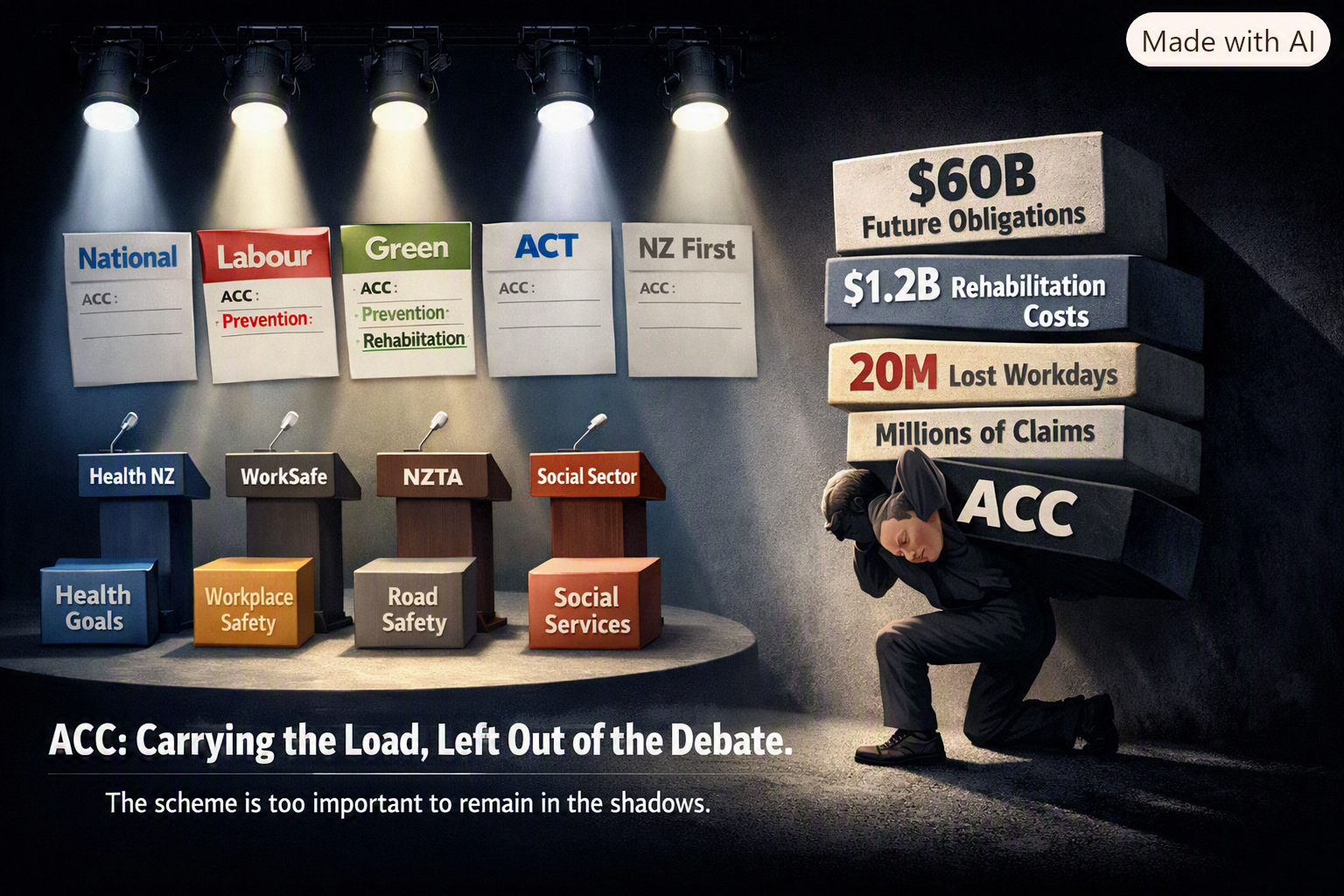
The ACC Futures Coalition is calling on political parties to give greater attention to one of New Zealand’s most important public institutions: the Accident Compensation Corporation (ACC).
Nearly fifty years after the implementation of the Woodhouse vision for a comprehensive, no‑fault injury compensation system, ACC remains a cornerstone of New Zealand’s social, economic and health infrastructure. Yet a review of current election manifestos shows ACC receives surprisingly little attention.
ACC provides far more than compensation. It funds treatment and rehabilitation, invests in injury prevention, supports safer workplaces and roads, and helps reduce the long‑term social and economic costs of injury. Despite this, ACC is largely absent from the policy agendas of most major political parties.
The Green Party Accident Compensation Policy is currently the most comprehensive ACC policy published, explicitly supporting stronger prevention, rehabilitation and health promotion. Labour has not released a dedicated ACC policy but has defended ACC’s prevention function and opposed cuts affecting road safety, workplace safety, family violence and sexual violence prevention programmes. Labour’s wider health platform emphasises prevention and early intervention.
The ACC Futures Coalition believes this creates an important opportunity.
If prevention is a cornerstone of Labour’s health policy, then ACC should be central to that conversation. ACC has a unique statutory role in injury prevention and a direct financial interest in reducing injuries before they occur. There is clear alignment between Labour’s focus on prevention and ACC’s role in reducing injury, supporting recovery and improving long‑term wellbeing.
Current policy platforms from National, ACT New Zealand, New Zealand First and The Opportunity Party contain little or no substantive discussion about ACC’s future direction, injury prevention, rehabilitation outcomes or ACC’s role in improving long‑term health and social outcomes.
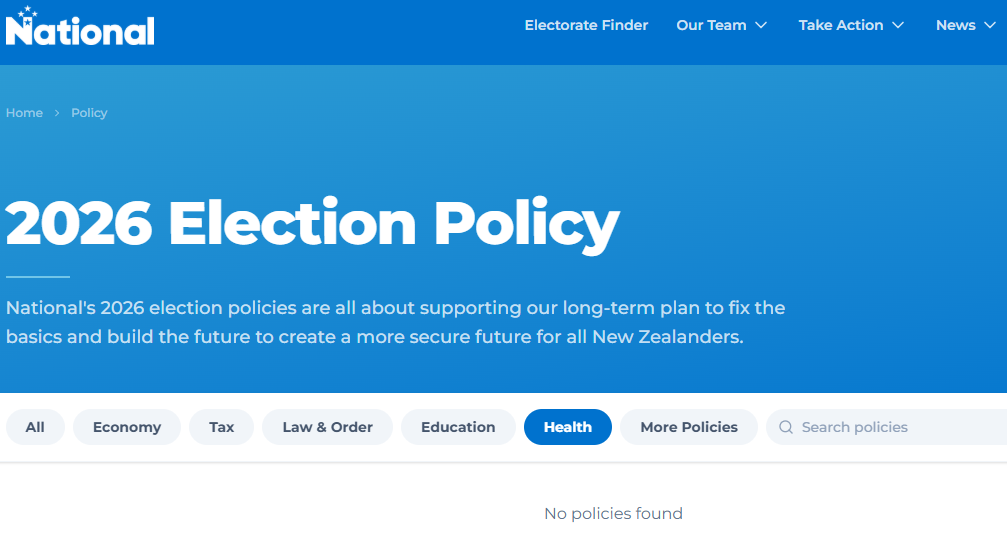
Pictured: National's 2026 Healthcare policies, retrieved 14/09/2026 from https://www.national.org.nz/policies.
ACC’s scale and significance are often under‑appreciated. ACC supports millions of injury claims each year, manages around $52 billion in investments, and carries future injury obligations exceeding $60 billion. It funds more than $1.2 billion annually in rehabilitation costs, including surgery, physiotherapy, home‑based support, vocational rehabilitation and long‑term recovery services.
Yet despite its scale and importance, ACC’s future is receiving remarkably little attention in this election campaign.
The Coalition believes the biggest unanswered policy question is not whether ACC should do more prevention, but how New Zealand organises itself to reduce injuries.
Road trauma is influenced by transport policy and infrastructure investment. Workplace injury is shaped by employer practices, industry leadership and regulatory settings. Fall prevention depends on health and aged‑care services. Violence prevention requires coordinated social sector action. In many cases, ACC pays the downstream costs when prevention fails, but it does not control the upstream decisions that determine injury outcomes.
If other government agencies do not invest in prevention, ACC inevitably carries the resulting costs through increased injury claims, treatment expenses, rehabilitation costs and future levy pressures.
New Zealand needs stronger prevention leadership, coordination and accountability across government - responsibility for preventing injuries is dispersed across multiple agencies with no clear system‑wide accountability. Prevention outcomes should not be left to ACC alone.
The economic case for prevention is compelling. ACC’s latest analysis estimates injuries cost New Zealand $8.7 billion in lost productivity every year, with more than 20 million workdays lost annually — equivalent to around 57,000 New Zealanders being absent from the workforce for an entire year.
Every serious injury prevented means fewer people requiring treatment, less time away from work, lower demand on health services, greater workforce participation and lower long‑term costs for ACC levy payers and taxpayers. Injury prevention is not simply a health issue — it is a productivity, economic and fiscal sustainability issue.
ACC’s future is not solely about compensation, treatment and prevention. It is also about public trust. As a monopoly social insurer, ACC relies on strong partnerships across the health, social and community sectors, and on public confidence that injured New Zealanders can access fair, transparent and timely review and appeal processes when decisions are disputed.
Important questions remain unanswered:
- Should ACC invest more heavily in primary injury prevention?
- What role should ACC play in addressing family violence and sexual violence?
- How should government establish stronger cross‑agency leadership and accountability for injury prevention outcomes?
- Who should be accountable for reducing New Zealand’s overall injury burden?
- How can ACC better leverage partnerships with Health NZ, WorkSafe, NZTA, local government, iwi and employers?
- How should New Zealand measure the return on investment from injury prevention?
- How should ACC respond to changing workforce risks, an ageing population and rising healthcare costs?
- Does the Accredited Employer (“AE”) scheme remain fit-for-purpose?
- What should the next fifty years of ACC look like?
Perhaps the most important question is whether New Zealand still a coherent national injury prevention strategy – the ACC Futures Coalition says no. Responsibility for preventing injuries is spread across transport, workplace safety, health, education, justice, local government and community sectors. Without stronger coordination, accountability and investment across government, New Zealand risks continuing to pay for preventable harm rather than preventing it.
In the Coalition’s view, a strong, reasoned solution for this problem already exists, just waiting to be implemented: FutureSafe Aotearoa. FutureSafe proposes the establishment of an oversight agency – FutureSafe – acting as the backbone that facilitates, oversees, and standardises interactions between critical agencies at all levels, from Ministries and Crown entities to industry and workers. The tools are already there. We just need a government willing to pick them up and use them. FutureSafe's phase one report can be downloaded here.
The ACC scheme touches almost every family, every community and every workplace in New Zealand. Fifty years after Woodhouse, New Zealand deserves a serious conversation about the future of ACC.
ACC was founded on the principle of community responsibility. In 2026 that principle should mean not only compensating and rehabilitating injuries, but ensuring government, businesses, communities and ACC work together to prevent them.
The scheme is simply too important to remain absent from the election debate.